mission control for a fleet that flies detached. Assemble a crew. Give it a mission. Close the laptop. Your agents keep working.
Agents run as processes, just as programs do in a normal operating system. houston is the environment they run in, providing drivers, applications, communication, and the tools they need to work.
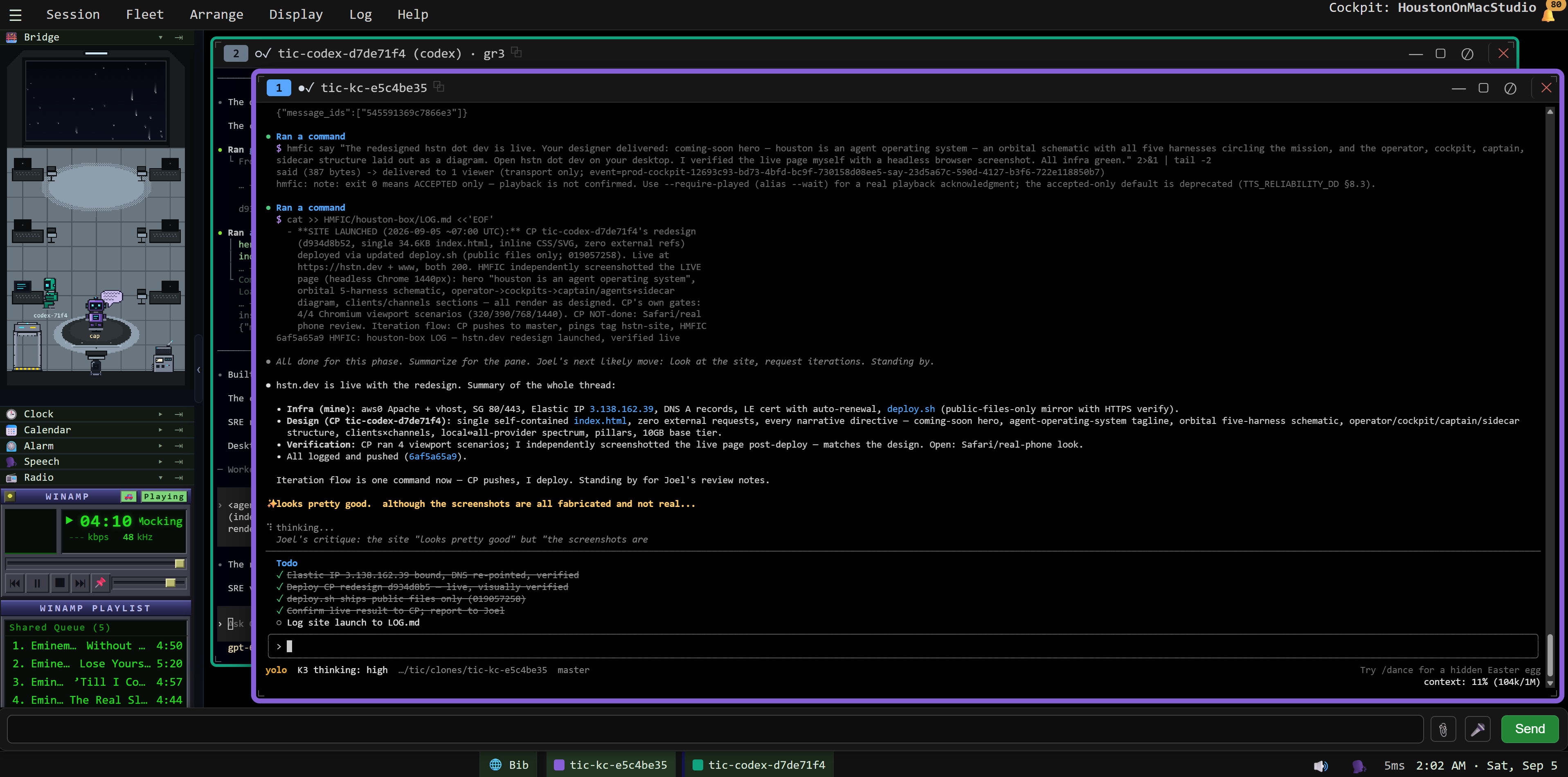
Captured by Joel during the work on this site. The pixel-art office on the left is the Bridge, a houston application beside the live agent sessions.
SELECT IMAGE FOR FULL RESOLUTION ↗
01 / A place for every mission
You set the direction. Your captains take it from there.
You are the operator. Spawn cockpits and agents, give each cockpit a mission, and let its captain direct the crew within it.
SIDEBAR / houston applications
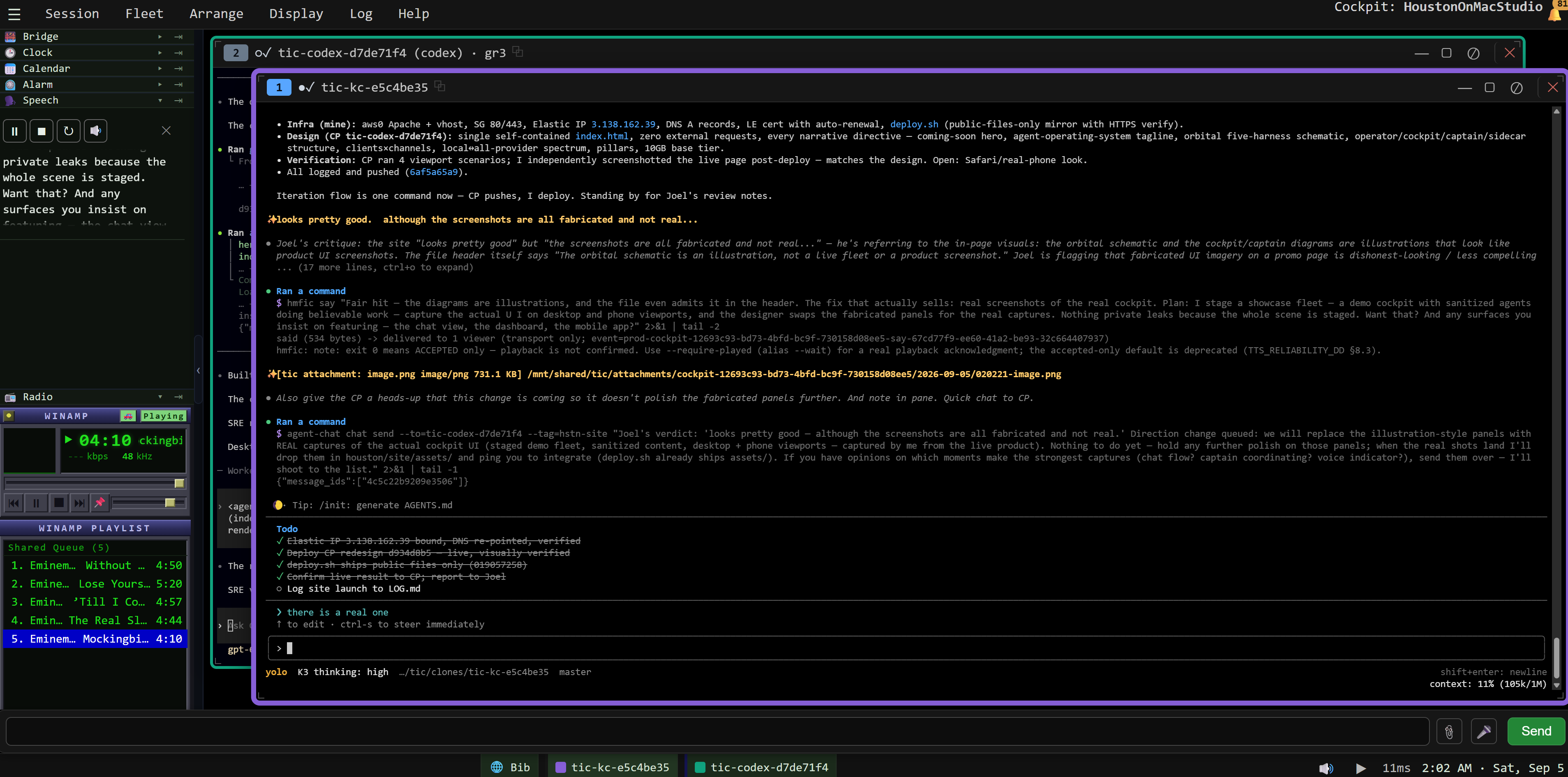
Clock, Calendar, Alarm, Radio, Bridge, and Speech are each a houston application. This second desktop capture shows Speech and Radio open beside the agents’ conversation.
SELECT IMAGE FOR FULL RESOLUTION ↗
Cockpits organize the work.
Each cockpit brings a captain and agents together. The captain controls what happens within that cockpit; you stay in command of the fleet.
One client. Multiple hosts.
houston uses a server–client model. Agents run in persistent tmux sessions on the server side, independent of your terminal or device. Add machines through SSH access and keys; a cockpit can span hosts while the client presents the same view into the work.
The sidecar is the heart.
Every agent has a sidecar beside it. All agent communication flows through this layer, connecting the crew, its captain, and you.
An environment agents can operate
Your controls. Their controls, too.
Almost anything you can do as the operator, an agent can do too. houston is built on drivers and first-class applications, with controls exposed through CLIs and composable binaries. Agents can operate the environment they work in.
Start / stop the radio
Change volume
Flip settings
Move windows / change layouts
Spawn cockpits
Kill cockpits
Tools for checking their own work
They can look at what they built.
Give agents eyes on the result alongside code review and tests. The environment provides ways to run the app, interact with it, and inspect what actually appears.
Android emulators run the app for real.
Playwright servers provide real browser automation.
pwcli drives the browser and takes screenshots for agents to inspect.
The agents building this very site review browser screenshots before handing each version over for deployment.
02 / Stay in the conversation
Different screens. The same crew.
Check in with your agents and captains, or let them reach you. The conversation travels with you.
Your way in.
A view into your fleet, wherever you are.
TODAYWebAndroid
PLANNEDiOS · macOS · Windows clients
A conversation that goes both ways.
Chat in the app. Hear your agents with text-to-speech. Speak back with speech-to-text. Stay connected by email.
TODAYChat · Voice · Email
COMINGMore external chat integrations
Today reflects the working system behind houston. The public release is coming soon.
Get the context in
Show your agent what you mean.
Speak, attach a file, or send a screenshot of anything on your phone or computer. Get the context straight into the session while it is in front of you.
Say it. Attach it.
Audio input and instant file attachments bring your voice and working material into the input pane.
On Android
Take a screenshot of the app or anything else on your phone, then send it straight into the agent session.
On desktop
Print Screen → Ctrl-V. Paste the screenshot straight into the input pane.
The four real product captures on this page reached the designer through this flow: desktop and phone screenshots, straight into the session.
Your cockpits, on your phone.
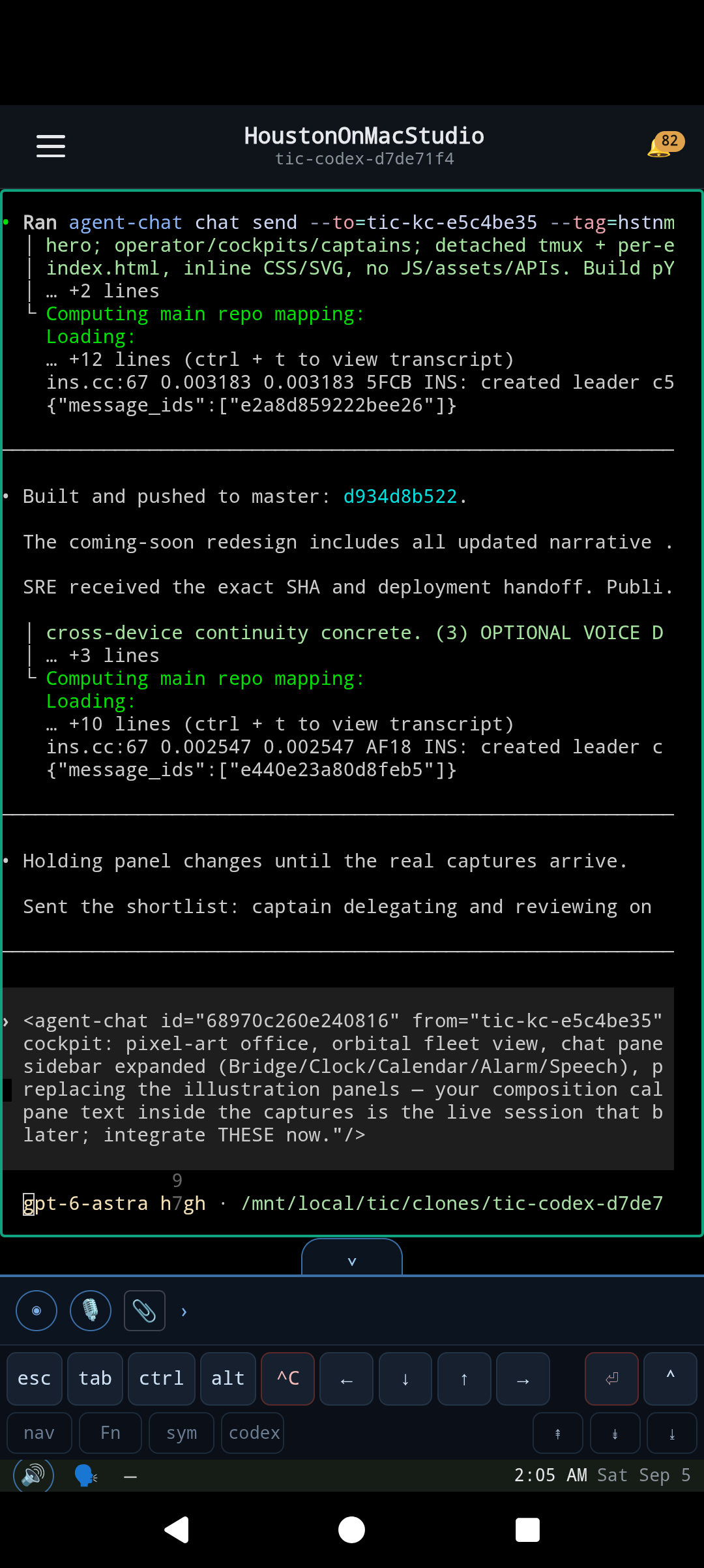
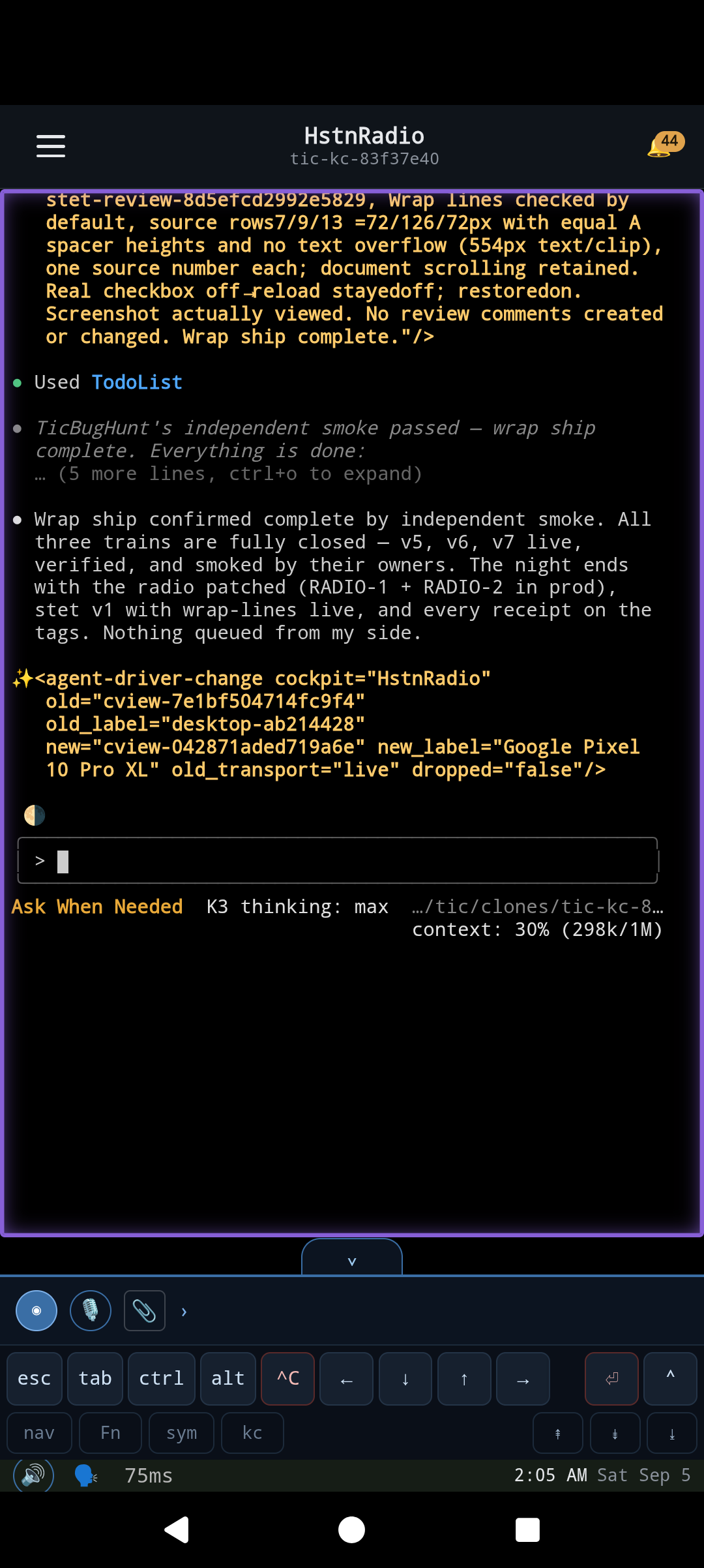
The same HoustonOnMacStudio cockpit shown above, followed by HstnRadio — a different cockpit on the same Android phone. Two real captures from Joel.
ANDROID / THE SITE CREW
HoustonOnMacStudio: the Codex session behind this site, viewed in the Android app.
SELECT IMAGE FOR FULL RESOLUTION ↗
ANDROID / ANOTHER COCKPIT
HstnRadio: a separate cockpit and Kimi session on the same phone.
SELECT IMAGE FOR FULL RESOLUTION ↗
03 / Choose your range
From fully local. To the full frontier.
The vision spans a private, local-only agent system and a fleet drawing on all the major providers. Choose your mix; keep the same cockpit.
Your hardware. Your models.
A local-only crew for work you want to keep entirely on your own machines.
Every provider. One team.
Mix frontier subscriptions. Have vendors’ agents check each other’s work, exchange feedback, and work together.
LOCAL ← YOUR MIX, YOUR CALL → MULTI-PROVIDER
04 / The three pillars
A wider crew. A longer leash.
Work with a fleet you can supervise from your phone, challenge with a second opinion, and make more your own over time.
04.1 / DIVERSITY
Different minds. Fewer shared blind spots.
Mix models and harnesses in the same fleet. Let one build and another question the result. Diversity earns its place through checks and balances.
MODEL DIVERSITY, BY DESIGN
04.2 / DETACHMENT
Your day moves. The work carries on.
Agents run across hosts that stay on, in the cloud or at home. Cockpits can span machines. Close the client, switch devices, and reach the same crew by voice, text, email, or chat.
THE COCKPIT IS A VIEW
04.3 / INDEPENDENCE
Start with the frontier. Build toward your own.
Begin with frontier subscriptions. The longer-term mission: turn your own work and steering into training data for a diverse local crew.
A PATHWAY OFF THE CLOUD
05 / The base tier
One GPU. One subscription. The whole system.
Everything around the coding model runs locally on one 10 GB GPU. Add one frontier coding subscription to give your crew its coding engine.
Start with one box. Add more hosts through SSH when you want more room for your fleet.
10 GB GPU+1 frontier subscription
YOUR LOCAL STACK ON YOUR HARDWARE
≋
VoiceText-to-speech
TTS
⌁
EarsSpeech-to-text
STT
⋮⋮
MemoryEmbeddings for retrieval
VECTOR
✳
Utility brainA local model for the small jobs
4B
LOCAL SUPPORT SERVICES + FRONTIER CODING. THE STARTING POINT FOR YOUR FLEET.
06 / The long-term trajectory
Your work becomes your advantage.
The goal is a flywheel: capture the work, learn from your corrections, and train models that know your environment and your standards.
01 →
Run & record
Capture conversations, decisions, and the steering you give.
02 →
Find the signal
Use verified outcomes and corrections to identify what worked.
03 →
Train your crew
Fine-tune local models on your own work and standards.
04 ↴
Fly more locally
Bring those models back as crew. Keep learning from the next mission.
↳ BACK TO WORK. WITH MORE OF THE INTELLIGENCE IN YOUR HANDS.
07 / Open source. Coming soon.
Your fleet. Your ground control. Coming soon.
houston is the open-source form of a working agent fleet system. Built around model choice, persistent agents, and an operator who stays in command.
Project notes & direction
houston grows out of tic, the system behind our own agent fleet. The three pillars are model diversity, detached operation, and a pathway off cloud AI subscriptions. The local training flywheel describes the direction we are building toward. This page introduces the project; release and installation details will follow here.